
September 30 is the National Day for Truth and Reconciliation in Canada. It is a time to recognize and commemorate the intergenerational harm that residential schools caused to Indigenous families and communities, and to honour those who have been affected by this injustice.
The National Centre for Truth and Reconciliation has planned a week of programming, running from September 21 to September 25. The programming includes a series of lunch and learns, social media content, and an event on Parliament Hill on September 30 intended to honour Survivors, pay tribute to the children who never made it home from residential schools, and deliver a safe and nurturing environment for reconciliation and healing.
We urge our members, staff and allies to take this opportunity to learn about and reflect on our past and how we can meaningfully participate in reconciliation in Canada.
The Truth and Reconciliation Commission and its Calls to Action
The Truth and Reconciliation Commission ran from 2008 to 2015, providing those directly or indirectly affected by the legacy of the Indian Residential Schools policy with an opportunity to share their stories and experiences. The Commission released its final report detailing 94 calls to action in 2015. The National Day for Truth and Reconciliation responds to Call to Action 80, which reads:
We call upon the federal government, in collaboration with Aboriginal peoples, to establish, as a statutory holiday, a National Day for Truth and Reconciliation to honour Survivors, their families, and communities, and ensure that public commemoration of the history and legacy of residential schools remains a vital component of the reconciliation process.
The National Centre for Truth and Reconciliation is a permanent archive for the statements, documents and other materials the Commission gathered, and its library and collections are the foundation for ongoing learning and research.
ONA’s Declaration on Truth and Reconciliation
In 2024, our ONA Board unanimously approved a Declaration on Truth and Reconciliation. This declaration reflects ONA’s core social justice values and establishes reconciliation as an organizational priority. We all have an important responsibility to advance truth and reconciliation as individuals, as nurses and health-care professionals and as ONA.
Events
- National Centre for Truth and Reconciliation Lunch and Learns: The National Centre for Truth and Reconciliation is hosting a series of Lunch and Learn webinars to UN-learn the myths of colonial history in Canada. The sessions are open to the public and will be hosted virtually over Zoom Webinar and streamed to YouTube. All sessions will have simultaneous English-French, and ASL interpretation. Register on the NCTR website.
- Doors Open - National Day for Truth and Reconciliation: In the lead-up to the National Day for Truth and Reconciliation, Rideau Hall will hold a special Doors Open event where visitors will have the chance to learn about Indigenous cultures, stories and traditions by viewing Indigenous artwork throughout the residence. Interactive art activities will also be offered, focused on learning and healing through art. On September 30, Rideau Hall will host a Sacred Fire for the community, led by an Indigenous fire keeper. Learn more on the Governor General of Canada website.
Orange Shirt Day
Orange Shirt Day started as part of the St. Joseph Mission (SJM) Residential School (1891-1981) Commemoration Project and reunion events that took place in Williams Lake, BC, Canada, in May 2013. The events were designed to commemorate the residential school experience, to witness and honour the healing journey of the survivors and their families, and to commit to the ongoing process of reconciliation.
Since then, every year on September 30, people across Canada wear orange shirts to raise awareness of, and start a conversation around, the history and legacies of the residential school system in Canada.
Read Phyllis Webstad’s story to learn more about how Orange Shirt Day came to be.
Materials
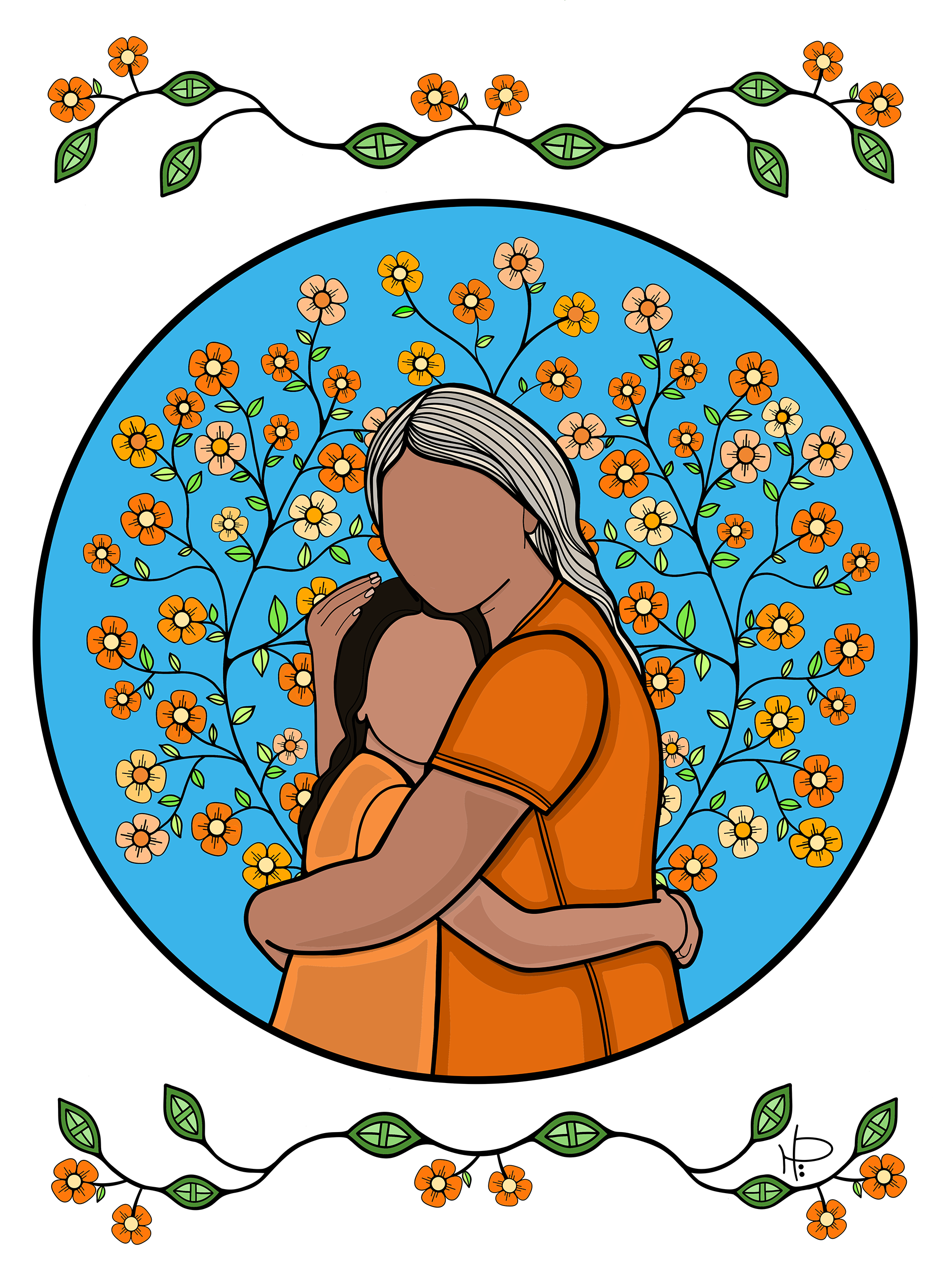
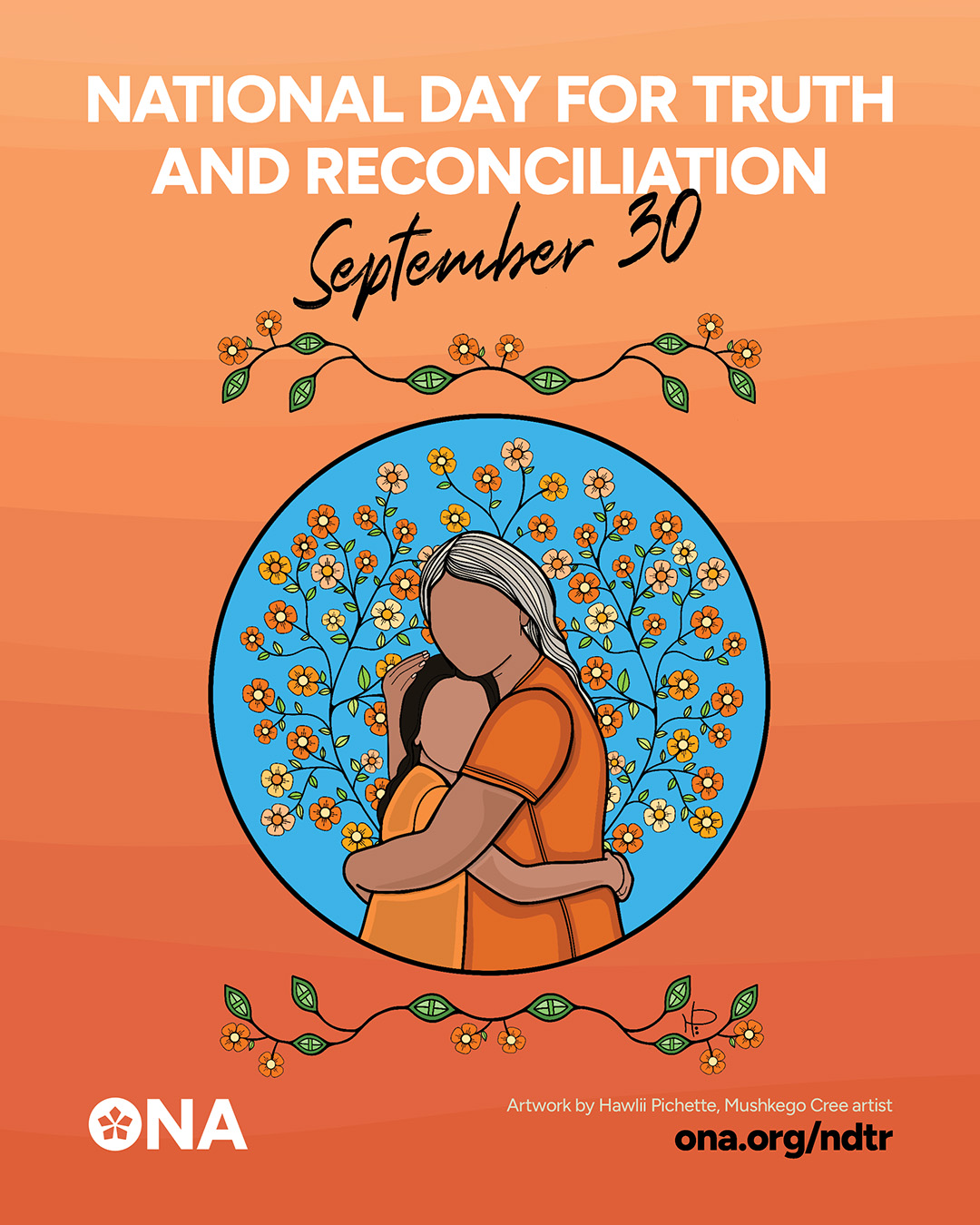
In the illustration, there is a grandchild and a grandmother hugging, they represent the multigenerational impacts that residential school has had on families. The fact that they are hugging represents the healing that is now taking place. The flowers flourishing in the background honour the memory of the many lives of the children and families impacted by the residential school system. And of course the figures are wearing orange shirts to honour September 30 (Orange Shirt Day).
Hawlii Pichette, Mushkego Cree artist
Learn More
- The National Centre for Truth and Reconciliation
- Understanding the National Day for Truth and Reconciliation
- Orange Shirt Society
- Gord Downie & Chanie Wenjack Fund
- Canadian Indigenous Nurses Association
- “Nursing and Indigenous peoples’ health: reconciliation in practice” By Maureen Fitzhenry
- Racism in Health Care Toolkits (Native Women’s Association of Canada)
- Telling Our Story (CBC Gem)
- #IndigenousReads reading list
- A Knock on the Door: The Essential History of Residential Schools from the Truth and Reconciliation Commission of Canada
- First Nations Child and Family Caring Society of Canada
- Ontario Federation of Labour – Anti-Racism Resource List
- Federal Anti-Racism Secretariat
- Ontario Human Rights Commission
- Learning resources about First Nations, Inuit and Métis across Canada
- Ontario Nurses’ Association - Anti-Racism, Equity and Human Rights Board Committee
- F-Work Magazine - Rights
- ONA Anti-Racism and Anti-Oppression Action Plan
- Ontario Nurses' Association - Land Acknowledgement
Anti-Racism and Anti-Oppression
ONA’s Anti-Racism Member Advisory Team and ONA’s Anti-Racism and Anti-Oppression Working Group launched a series of resources to continue to bring awareness to current issues impacting those who are Indigenous, Black, Racialized and members of historically marginalized communities.
Visit our Anti-Racism and Anti-Oppression page for the latest news and resources, including our Anti-Racism and Anti-Oppression Action Plan. For further information, questions or comments, email arao@ona.org.

